

A 50-year-old man, originally from India, presents with neck pain, high fever, and a progressively enlarging swelling beneath the right side of his jaw. He describes difficulty swallowing and some discomfort when speaking but no frank airway obstruction at present. The symptoms began two days ago and have worsened despite paracetamol and over-the-counter analgesia.
On examination:
- He is febrile (temperature 39.5°C) and tachycardic (heart rate 108 bpm).
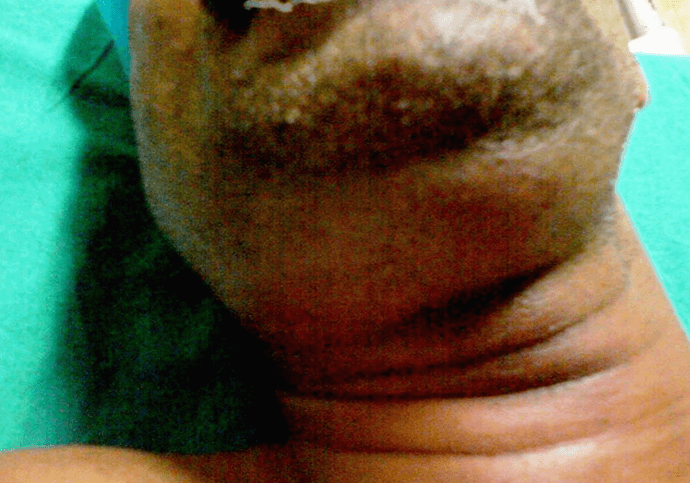
- There is a firm, tender, non-fluctuant swelling in the right submandibular region, extending below the angle of the jaw.
- The floor of his mouth is oedematous and mildly raised.
- His voice is slightly muffled, but his oxygen saturation is normal on room air.
- There are no signs of trismus or stridor at present, though he appears clinically septic.
A photo of his neck is shown below:
Show Answer
This presentation is highly suggestive of Ludwig’s angina — a rapidly progressive and potentially life-threatening cellulitis of the submandibular space, usually involving both the sublingual and submaxillary compartments.
The infection often originates from the floor of the mouth or lower molar teeth and spreads through connective tissue planes. It causes significant soft tissue swelling and carries a high risk of airway compromise due to posterior tongue displacement and supraglottic oedema.
Key clinical features include:
- Bilateral or unilateral submandibular swelling
- Firm, non-fluctuant swelling (due to cellulitis, not abscess)
- Oedema of the floor of the mouth and tongue elevation
- Features of sepsis: fever, tachycardia, systemic upset
- Muffled voice, dysphagia, or dyspnoea in more severe cases
Question image sourced from Wikipedia. Courtesy of Anand H Kulkarni et al. CC BY-SA 2.0.
Show Answer
Ludwig’s angina is usually polymicrobial, with both aerobic and anaerobic bacteria commonly involved.
The most frequently isolated organisms include:
- Streptococcus viridans (most common overall)
- Staphylococcus aureus
- Bacteroides species
- Fusobacterium
- Klebsiella species
- Escherichia coli
- Enterococcus faecalis
- Pseudomonas aeruginosa (especially in immunocompromised patients)
Given the mix of anaerobic and aerobic flora, empirical antibiotic therapy should be broad spectrum until sensitivities are known.
Show Answer
Risk factors include:
- Poor dental hygiene
- Recent dental infection or extraction, particularly of lower molars
- Diabetes mellitus
- Immunosuppression (e.g. corticosteroid use, HIV, chemotherapy)
- Alcohol dependence or malnutrition
- Smoking
- Living in or travelling from regions with limited dental access
In many cases, no single causative event is identified, but lower molar infections remain the most common source.
Show Answer
The most dangerous and potentially fatal complication of Ludwig’s angina is airway obstruction.
Swelling of the floor of the mouth can lead to elevation and posterior displacement of the tongue, causing:
- Partial or complete airway obstruction
- Stridor, hypoxia, and respiratory arrest, if not promptly addressed
Emergency management priorities:
- Immediate transfer to an Emergency Department via blue-light ambulance
- Early assessment in a high-acuity area (e.g. resuscitation bay)
- Urgent airway evaluation — early involvement of anaesthetics/ENT for possible intubation or surgical airway
- IV antibiotics (e.g. co-amoxiclav or a combination of ceftriaxone + metronidazole)
- Consider imaging (CT neck with contrast) to evaluate for deep space infection or abscess if the airway is stable
In advanced cases, surgical drainage may be necessary if an abscess forms, although initially, Ludwig’s angina is classically non-fluctuant and cellulitic in nature.

Teaching Points
✅ Ludwig’s angina is a surgical emergency due to the risk of airway compromise.
✅ Early recognition and transfer to hospital is essential — do not delay for imaging or outpatient review.
✅ The condition is typically polymicrobial and should be treated with broad-spectrum IV antibiotics.
✅ Airway safety always comes first — this may require intubation or surgical intervention.
✅ Risk factors such as poor dental hygiene and diabetes are commonly present and should be addressed in the long term.
Header image used on licence from Shutterstock