
A classic high-yield topic. Looks complicated. It isn’t, if you break it down correctly.

Mnemonic First
Rugby Teams Drink Cold Beers
→ Roots → Trunks → Divisions → Cords → Branches
Anatomical Breakdown
ROOTS (C5–T1):
- 5 anterior rami: C5, C6, C7, C8, T1
- Pass between anterior and middle scalene
TRUNKS:
- Upper = C5 + C6
- Middle = C7
- Lower = C8 + T1
DIVISIONS:
- Each trunk splits into anterior and posterior divisions
→ 6 total divisions (3 anterior, 3 posterior)
CORDS (named in relation to the axillary artery):
- Posterior cord = all 3 posterior divisions
- Lateral cord = anterior divisions of upper + middle trunks
- Medial cord = anterior division of lower trunk
TERMINAL BRANCHES (Major 5):
- Musculocutaneous (C5–C7)
- Axillary (C5–C6)
- Radial (C5–T1)
- Median (C6–T1)
- Ulnar (C8–T1)
Smaller Branches – Know Their Origins
From ROOTS:
- Dorsal scapular nerve
- Long thoracic nerve
From TRUNKS:
- Suprascapular nerve
- Nerve to subclavius
From LATERAL CORD:
- Lateral pectoral nerve
From POSTERIOR CORD:
- Upper + lower subscapular nerves
- Thoracodorsal nerve
From MEDIAL CORD:
- Medial pectoral nerve
- Medial cutaneous nerves (arm + forearm)
Brachial Plexus Lesions – What You Need to Know
Erb’s Palsy (Upper Plexus – C5/C6)
- Cause: Shoulder trauma, difficult birth (traction)
- Arm position: Adducted, extended, pronated → “Waiter’s tip”
- Nerves involved: Axillary, musculocutaneous, suprascapular
- Motor loss:
- Shoulder abduction (deltoid, supraspinatus)
- External rotation (infraspinatus)
- Elbow flexion (biceps, brachialis)
- Sensory loss: Lateral arm
Klumpke’s Palsy (Lower Plexus – C8/T1)
- Cause: Traction during arm abduction or apical lung tumour (Pancoast)
- Hand position: Claw hand (intrinsic hand muscle paralysis)
- Nerves involved: Median and ulnar
- Motor loss: All small muscles of the hand
- Sensory loss: Medial forearm and hand
- +/- Horner’s syndrome (if T1 involved)
Quick Table – Compare Erb’s vs Klumpke’s
| Feature |
Erb’s Palsy
|
Klumpke’s Palsy |
| Roots |
C5–C6
|
C8–T1 |
|
Main nerves
|
Axillary, Musculocutaneous
|
Median, Ulnar
|
|
Motor signs
|
Loss of shoulder abduction, elbow flexion
|
Claw hand – intrinsic hand weakness
|
|
Sensory loss
|
Lateral arm
|
Medial forearm + hand
|
|
Arm position
|
“Waiter’s tip”
|
Clawed hand |
|
Extra signs
|
– |
± Horner’s syndrome (T1)
|
Key Exam Tips
Always mention root levels, nerve names, motor function, and sensory loss when describing injuries.
Learn the posterior triangle—brachial plexus is palpable there.
Practice drawing the plexus from memory. The stylised “M” of the terminal branches (musculocutaneous, median, ulnar) is a visual anchor.
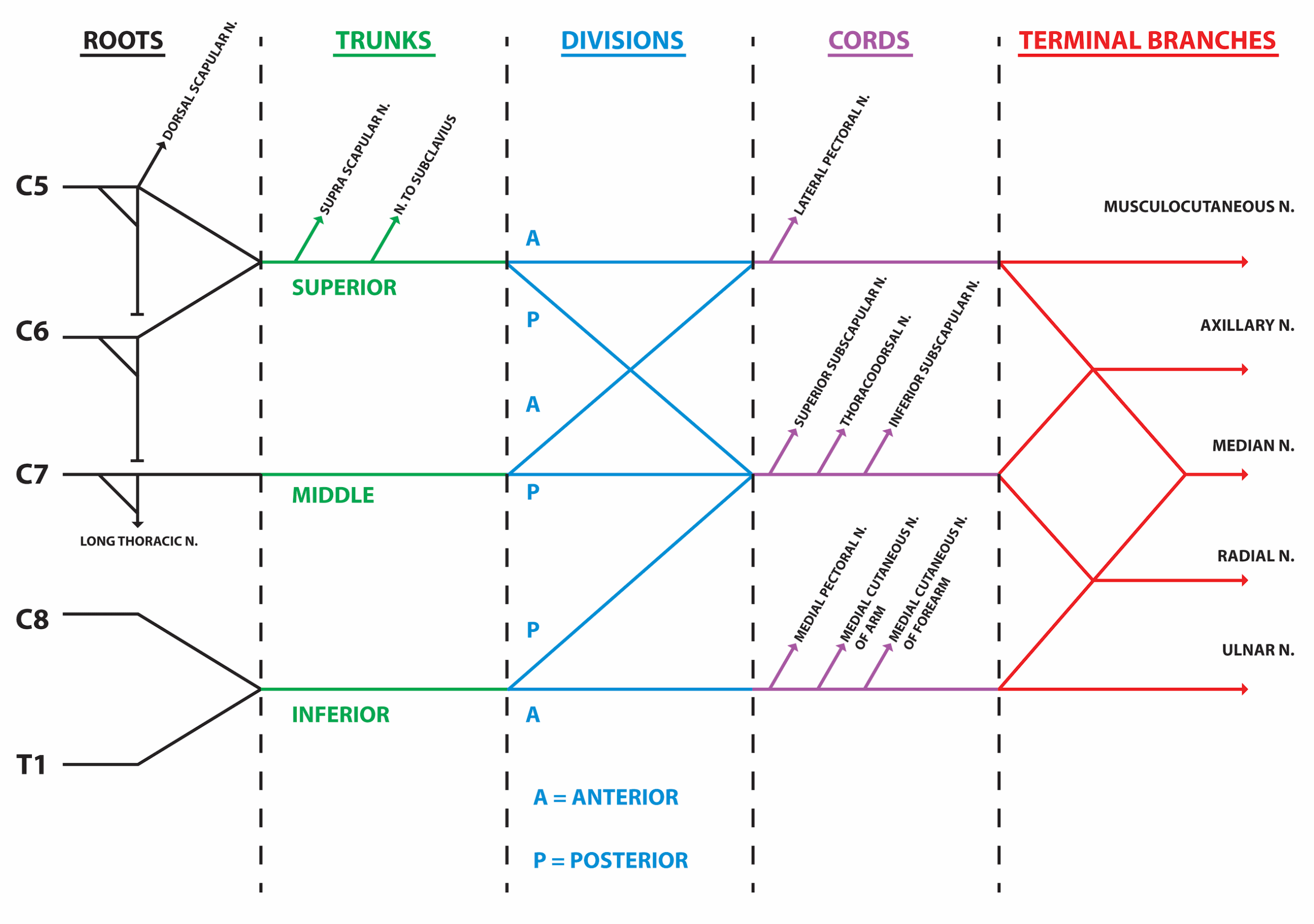
Stylised version of the brachial plexus. © Medical Exam Prep
For thousands more anatomy tutorials and questions visit: www.anatomyprep.co.uk
Header image used on licence from Shutterstock